Why tokenization platforms fail
Most tokenization projects ship a smart contract and call it done. In production, that contract is 10% of the system. The other 90% is what breaks: issuance lifecycle management, integration with KYC/AML providers, transfer restriction logic (ERC-3643 or ERC-1400), backend services for issuer operations, event indexing for compliance reporting, and safe upgrade paths when regulations change.
With MiCA enforcement starting July 2026, EU-based issuers need platforms that handle investor classification, asset-referenced token reserves, and whitepaper publication requirements at the infrastructure level - not as afterthoughts. Platforms built without these constraints in mind require expensive rewrites or, worse, fail compliance audits.
We build tokenization platforms that handle the full lifecycle: from asset modeling and smart contract architecture through backend integrations, indexing, and production operations. Our systems run at Alior Bank (public Ethereum, since 2019) and Soil.co (XRPL stablecoin flows). We support ERC-3643, ERC-1400, and XRPL-native issuance depending on the regulatory and technical requirements.
What you get
Production tokenization platforms require more than smart contracts. We deliver end-to-end systems: asset modeling, backend services, integrations, indexing, and operational support.
We build the core layers that make tokenization usable in real operations - not just a contract on-chain.
Asset model & lifecycle design
+Define ownership model, issuance/redemption flows, transfer rules, and lifecycle events. Output: clear spec that maps business rules to on-chain + backend components.
Smart contracts
+Implement token logic, permissions, upgrades, and robust test coverage. Output: production-ready Solidity (and XRPL flows when applicable) plus deployment pipelines.
Backend services & integrations
+Issuer/investor workflows integrated with your existing stack and third-party providers you choose. Output: APIs, services, and integration hooks for onboarding, ops, and reporting.
Indexing, reporting & data integrity
+Turn blockchain events into usable operational data for finance, ops, and product teams. Output: indexers, data pipelines, and audit-friendly reporting outputs.
Launch readiness & production support
+Make releases safe and systems observable under real load. Output: monitoring, runbooks, incident response basics, and post-launch support.

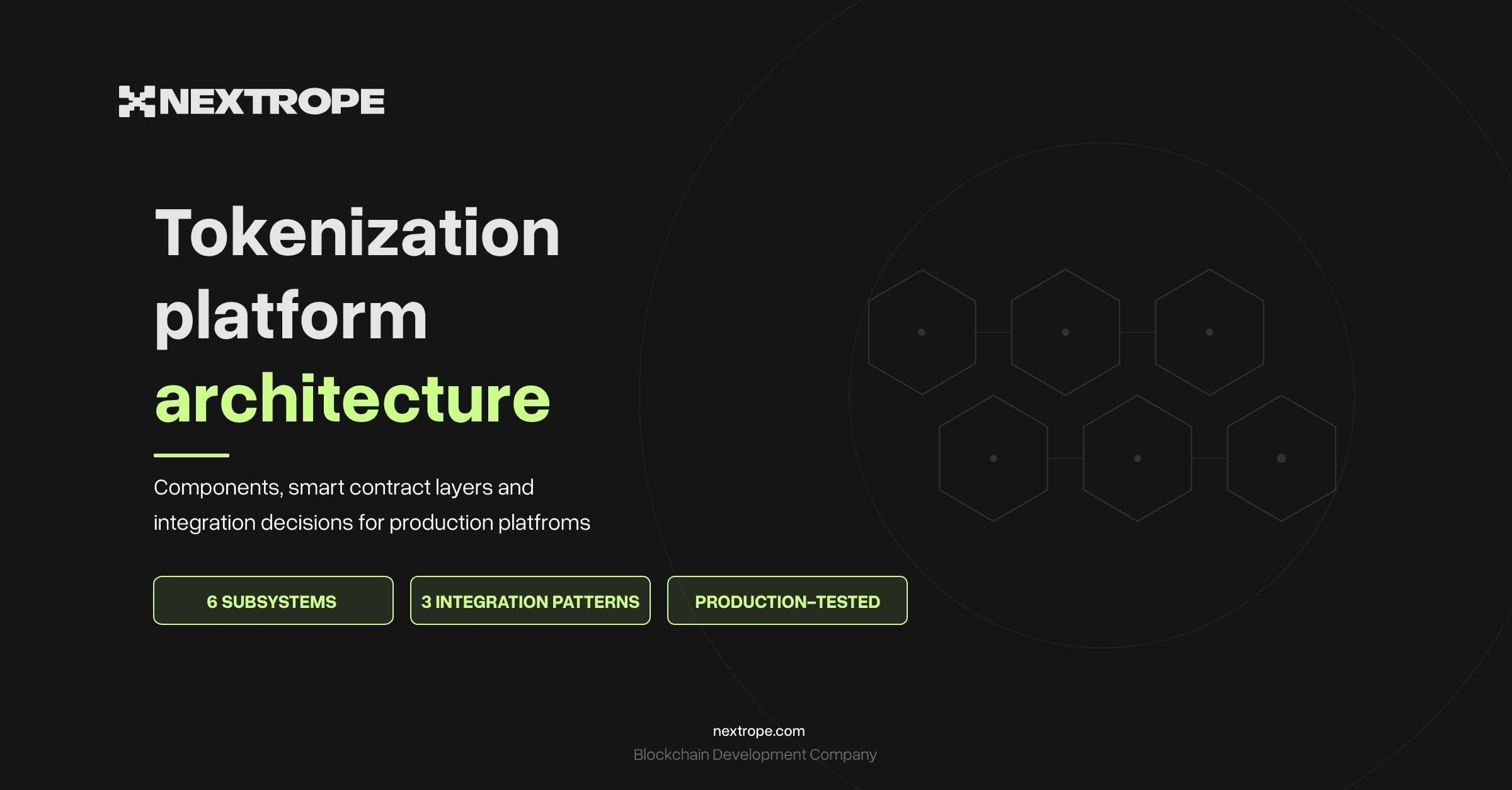
Core architecture
Issuer ops layer
+Admin workflows, approvals, and lifecycle controls.
On-chain layer
+Token contracts, permissions, upgrades.
Integration layer
+Onboarding/identity providers, internal systems, analytics.
Data layer
+Indexers, event pipelines, operational reporting outputs.
Support layer
+Monitoring, runbooks, safe release practices.
Common use cases
Real-world tokenization scenarios where production infrastructure matters.
Private credit & receivables
+Tokenized issuance flows and lifecycle events connected to real-world asset operations.
Commodity-backed assets
+Issuance and redemption-oriented flows with strong operational traceability.
Real estate / fund-style structures
+Ownership models and lifecycle logic designed around real constraints and integrations.
Enterprise proof + verification layers
+When tokenization needs verifiable proofs or long-term integrity anchoring (e.g., regulated document flows).
How we work
Related Case Studies




Tokenization Platforms - Frequently Asked Questions
- What does a tokenization platform include beyond smart contracts?
- The smart contract is roughly 10% of the system. The other 90% includes issuance lifecycle management, KYC/AML provider integrations, transfer restriction logic (ERC-3643 or ERC-1400), backend services for issuer operations, event indexing for compliance reporting, and safe upgrade paths when regulations change.
- Which token standards do you work with?
- We support ERC-3643 (formerly T-REX) and ERC-1400 for regulated security tokens on EVM chains, and native XRPL issued currencies for XRPL-based issuance. The choice depends on regulatory context, transfer restriction requirements, and whether on-chain compliance logic is needed.
- How does MiCA affect tokenization platform requirements?
- MiCA enforcement starting July 2026 requires EU-based issuers to handle investor classification, asset-referenced token reserves, and whitepaper publication requirements at the infrastructure level. Platforms not designed with these constraints need expensive rewrites or fail compliance audits.
- Do you have production tokenization references?
- Yes. Our primary references are Alior Bank (public Ethereum, running since 2019) and Soil.co (XRPL stablecoin flows). Both are live production systems handling real transactions, not POCs.