Introduction
AI smart contract auditing is rapidly changing the smart contract security industry.
AI-powered auditing platforms and modern security review programs are helping security researchers and development teams identify vulnerabilities faster than ever before. At the same time, large language models are becoming increasingly capable of reviewing Solidity code, explaining attack vectors, and generating security findings in minutes rather than days.
As a result, many organizations are starting to ask a practical question: Do we still need human smart contract auditors?
It is a reasonable question. Modern AI systems can detect many common vulnerability classes, analyze thousands of lines of code almost instantly, and significantly reduce the manual effort required during security reviews.
Yet many of the largest blockchain exploits in recent years were not caused by coding mistakes at all. Instead, they emerged from business logic flaws, economic incentives, governance weaknesses, and complex interactions between multiple protocols.
This creates an important distinction.
Finding vulnerabilities is only one part of a smart contract audit.
Understanding how a protocol can fail in production is often a much more difficult problem.
In this article, we examine what AI-powered smart contract auditing can realistically achieve today, where it provides the most value, where it still struggles, and whether it can replace experienced security researchers in modern blockchain security programs.
What Can AI Smart Contract Auditing Do Today?
Modern AI-powered smart contract auditing combines large language models with established security tooling.
These systems analyze source code, identify recurring vulnerability patterns, prioritize areas of higher risk, and generate preliminary findings that can be reviewed by security engineers.
Most production-grade auditing workflows combine AI-assisted analysis with static analysis, automated testing, and other deterministic security checks to improve both coverage and reliability.
As a result, AI can review large Solidity codebases in minutes, helping teams identify common vulnerabilities much earlier in the development lifecycle.
Unlike traditional audits, AI-powered agents can operate continuously, reviewing pull requests, analyzing new code, and identifying potential vulnerabilities as the codebase evolves.
As a result, AI-assisted auditing is becoming a standard component of modern blockchain security workflows. For security teams, this means vulnerabilities can be identified earlier in the development lifecycle, reducing remediation costs and improving deployment velocity.
What Smart Contract Vulnerabilities Can AI Detect Reliably?
Many of the vulnerabilities reported in public smart contract audits follow recurring implementation patterns that are well suited to automated detection.
Examples include:
- Reentrancy attacks – External calls performed before critical state updates follow a well-known pattern that can be identified automatically.
- Arithmetic errors – Unsafe numerical operations such as overflows, underflows, and incorrect calculations are straightforward to detect through automated analysis.
- Timestamp manipulation – Functions that depend directly on block.timestamp and other time-sensitive inputs can be flagged for further review.
- Access-control vulnerabilities – Missing ownership checks, improperly protected administrative functions, and other authorization-related weaknesses are common candidates for automated detection.
- Logical implementation mistakes – Result from incorrect ordering of operations, missing edge-case handling, or flawed assumptions in contract logic. These issues often follow recurring patterns observed in previous audits.
- Dependency-related risks – Trust assumptions around external contracts, libraries, and oracle providers can be analyzed to identify potential dependency weaknesses.
- Dynamic execution issues- Involve mechanisms such as delegate call, fallback functions, and proxy architectures that alter execution behavior at runtime. Automated tools look for patterns that may enable unintended code execution.
These categories account for a significant portion of vulnerabilities reported in public smart contract audits, making them ideal candidates for AI-assisted detection.
Because these vulnerability classes have appeared thousands of times across Solidity codebases, AI systems are increasingly effective at identifying them automatically.
What Vulnerabilities Does AI Still Miss?
While AI performs well on known vulnerability patterns, many of the most expensive blockchain exploits are not caused by coding mistakes.
Instead, they emerge from business logic, economic incentives, and unexpected interactions between multiple systems.
For example, a DeFi protocol may function exactly as designed while still allowing users to manipulate liquidity, abuse incentive structures, or extract value through unforeseen market behavior.
Similarly, tokenization platforms and stablecoin infrastructures often depend on multiple contracts, external oracles, governance mechanisms, and third-party integrations. Each component may appear secure in isolation while introducing risk when combined.
AI can help identify these issues, but understanding them often requires context that extends beyond the source code itself.
This remains one of the primary reasons why experienced security researchers continue to play a critical role in modern smart contract audits.
Can AI Replace Traditional Audits?
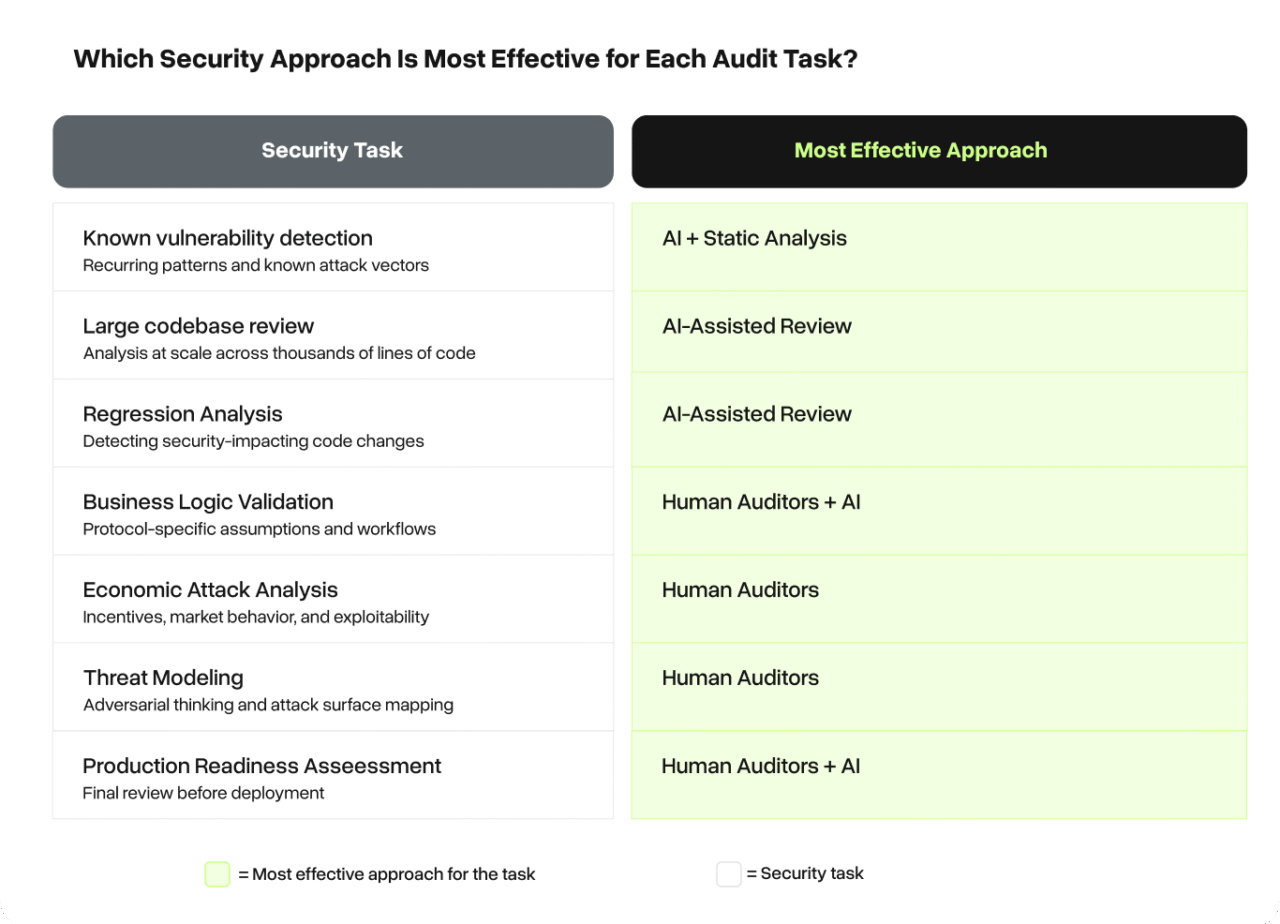
The answer depends on the system.
For prototypes, internal applications, and lower-risk deployments, AI-powered auditing can often identify the majority of common security issues at a fraction of the cost and time of traditional reviews.
For high-value systems such as stablecoins, tokenization platforms, and complex DeFi protocols, AI should be viewed as an additional layer rather than a complete replacement.
The most significant change is not that AI replaces auditors. It is that AI enables auditors to review more code, investigate more attack paths, and focus their attention on business logic rather than routine vulnerability discovery.
As AI-powered auditing tools and competitive security review programs continue to evolve, security workflows are becoming increasingly AI-first. Human expertise remains critical, but organizations that successfully combine AI-assisted analysis with experienced reviewers can achieve broader coverage and faster security reviews.
What Does a Modern Smart Contract Security Workflow Look Like?
The most mature blockchain teams are increasingly adopting a layered security model that combines AI-assisted analysis, automated testing, and expert review.
Modern security programs combine multiple forms of automated analysis with expert review, with each layer addressing a different category of risk:
AI-assisted review for continuous code analysis and early vulnerability discovery.
- Static analysis to identify known vulnerability patterns, code-quality issues, and access-control weaknesses.
- Fuzzing and automated testing to uncover unexpected runtime behavior and edge cases.
- Formal verification to validate critical protocol assumptions and security properties.
- Expert auditor review focused on business logic, threat modeling, architecture decisions, and economic risks.
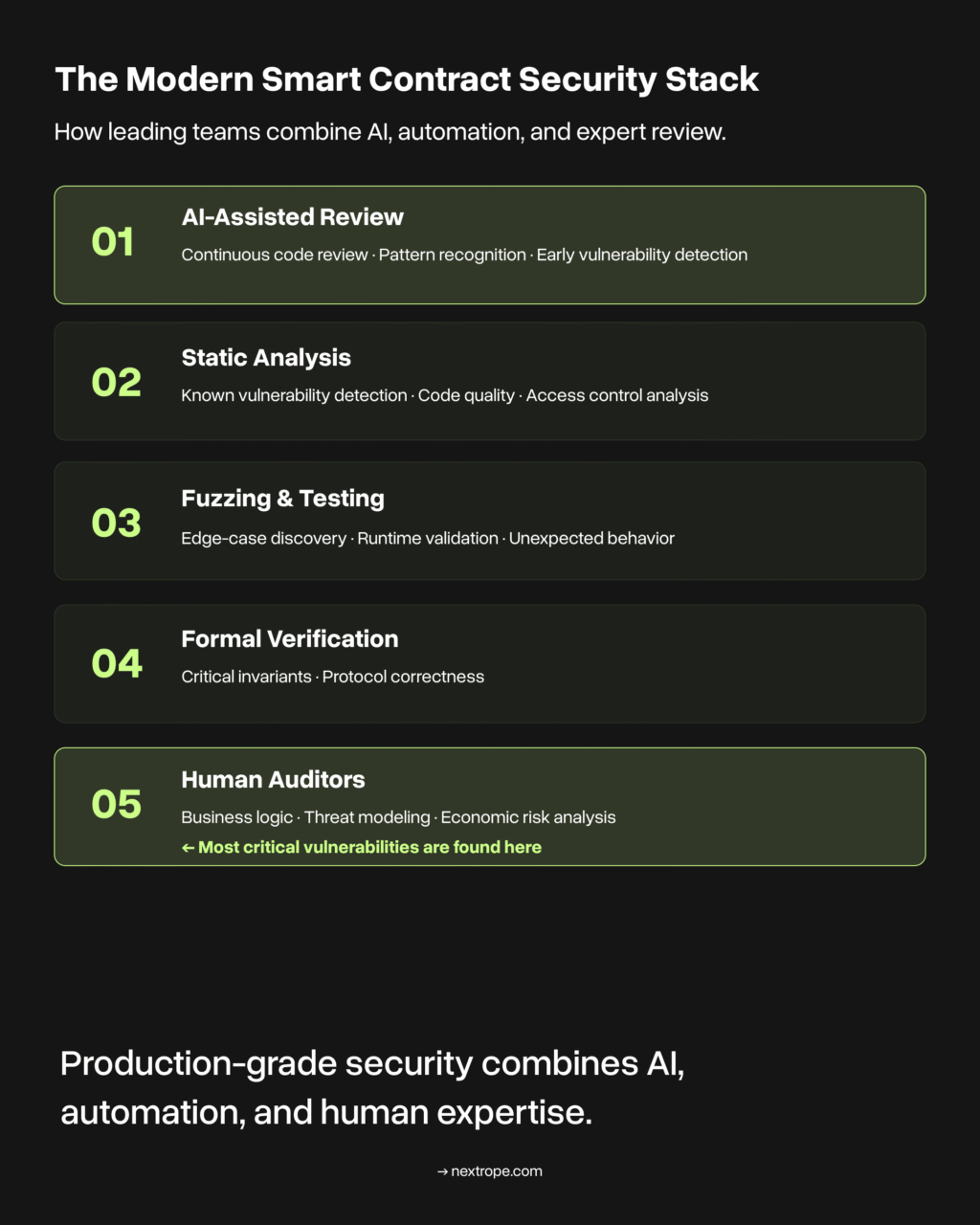
Each layer contributes something different.
AI-assisted review improves speed and scalability.
Static analysis identifies known vulnerability patterns.
Fuzzing and testing uncover unexpected execution paths and runtime behavior.
Formal verification validates critical assumptions and protocol invariants.
Expert auditors evaluate business logic, architecture decisions, and economic attack surfaces.
The strongest security programs do not treat these approaches as alternatives. Instead, they combine them to achieve broader coverage than any single technique can provide.
As AI-assisted tooling continues to mature, security teams are increasingly integrating automated analysis throughout the development lifecycle. This allows auditors to focus more attention on architecture review, threat modeling, and business logic validation while automation handles a growing portion of routine vulnerability discovery.
Conclusion
AI is rapidly changing how smart contract audits are performed.
Modern AI-powered auditing systems can identify many known vulnerability classes faster than ever before, helping teams improve security earlier in the development lifecycle.
At the same time, business logic flaws, economic exploits, governance risks, and cross-protocol dependencies remain difficult to fully automate.
As a result, the industry is not moving toward AI-only security reviews.
Instead, it is converging on a hybrid model that combines AI-assisted analysis, automated testing, formal verification, and experienced human auditors.
For organizations building stablecoins, tokenization platforms, DeFi protocols, or other high-value blockchain applications, the strongest security outcomes increasingly come from combining these approaches rather than choosing one over another.
The organizations achieving the strongest security outcomes are not choosing between AI and human auditors. They are combining both. Increasingly, that process starts with AI agents operating continuously throughout development rather than only during formal audit engagements.
As AI-powered security platforms continue to mature, teams that integrate automated auditing into their development lifecycle can identify vulnerabilities earlier, improve audit efficiency, and achieve broader security coverage.
The question is no longer whether AI belongs in the smart contract audit process.
The question is how quickly organizations can take advantage of it.
How Can Teams Get Started with AI-Powered Auditing?
The smart contract security industry is moving toward AI-first workflows.
Teams that adopt AI-assisted auditing can identify vulnerabilities earlier, improve developer productivity, and reduce the number of issues reaching formal audits. However, for high-value applications such as MiCA-compliant tokenization platforms, stablecoin infrastructure, and DeFi protocols, success depends on more than simply deploying AI tools. It requires integrating AI into a broader security strategy.
The strongest security programs combine AI-assisted analysis with static analysis, testing, formal verification, and expert review. Each layer addresses different categories of risk and contributes to a more resilient development process. As AI-powered auditing becomes more widely adopted, teams relying exclusively on manual review may struggle to match the speed and coverage achieved by organizations that integrate automated analysis throughout development.
Organizations evaluating AI-powered auditing agents should start by assessing their current security workflow. Identifying coverage gaps, review bottlenecks, and opportunities for automation can help teams improve security without slowing development.
At Nextrope, we help blockchain teams integrate AI-powered auditing into their development lifecycle, enabling faster reviews, broader security coverage, and stronger production readiness.
If you are evaluating how AI-powered auditing can improve your security workflow, we can help identify where automation delivers the greatest impact and how to integrate it into existing audit processes.
Let’s talk about your security strategy.