The Security Risks Most Teams Miss
Tokenization platform security extends far beyond smart contract audits.
Most tokenization teams invest heavily in securing Solidity code through audits, testing, and automated analysis. Yet many of the most damaging incidents do not originate from smart contract vulnerabilities.
Instead, they emerge from governance failures, compromised administrative access, weak operational controls, compliance system failures, and insecure off-chain infrastructure.
Unlike many DeFi applications, tokenization platforms combine token contracts with investor onboarding systems, custodians, compliance engines, issuer administration tools, APIs, and backend services. Each component introduces additional trust assumptions and attack vectors.
As a result, organizations evaluating tokenization platform security must look beyond smart contracts and assess the broader ecosystem supporting the platform.
The following security observations appear repeatedly during tokenization platform audits, architecture reviews, and blockchain security assessments.
Why Tokenization Platforms Create Unique Security Challenges
A modern tokenization platform typically combines token contracts, compliance systems, custodial integrations, investor onboarding workflows, APIs, and backend infrastructure.
Each component introduces additional trust assumptions and potential attack vectors.
A smart contract may be thoroughly audited, yet the platform can remain vulnerable through compromised administrator accounts, flawed compliance workflows, insecure APIs, or governance weaknesses.
Unlike traditional smart contract projects, tokenization platforms must secure not only code but also operational processes, privileged access, business logic, and external dependencies.
The architecture below illustrates the components commonly found in institutional-grade tokenization platforms.
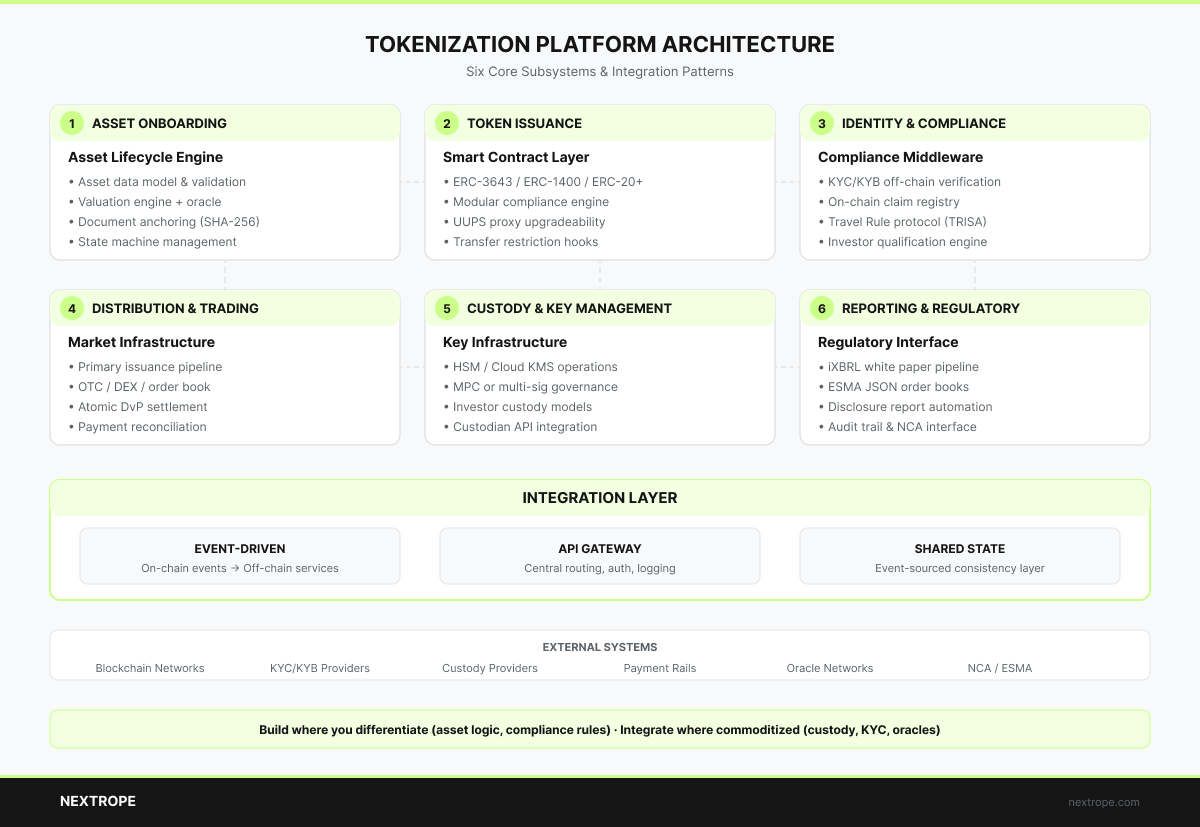
For a deeper breakdown of the components that make up a production-grade tokenization platform, see our guide to Tokenization Platform Architecture.
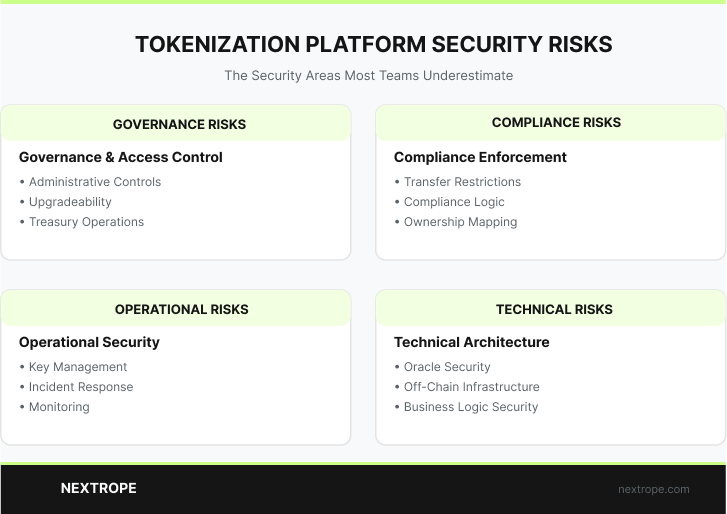
The Four Security Domains Most Teams Underestimate
These domains extend well beyond smart contract security and often expose weaknesses that traditional code audits fail to identify.
Governance Risks
Governance failures rarely originate from smart contract vulnerabilities. Instead, they emerge from excessive privilege, weak approval workflows, and centralized control structures.
1. Admin Roles Are Too Powerful
Most tokenization platforms spend months hardening smart contracts while giving a handful of admin wallets the ability to bypass every security control in the system.
A typical admin can:
- mint tokens,
- freeze investors,
- modify compliance rules,
- upgrade contracts
At that point, the smart contract is no longer the primary trust assumption.
The administrator is.
In security reviews, we often find organizations with well-audited contracts but no clear inventory of who actually controls privileged operations.
A compromised admin wallet can have a larger impact than any Solidity vulnerability.
The question isn’t whether admin powers exist.
The question is whether anyone has verified that they are truly necessary.
2. Upgradeability Creates a New Attack Surface
Many teams audit the current implementation and forget that users will interact with future implementations as well.
The moment a platform becomes upgradeable, the upgrade process itself becomes critical infrastructure.
We’ve seen environments where:
- upgrade keys were less protected than production infrastructure,
- no independent review was required before deployment,
- governance approvals existed only on paper.
In these cases, the proxy architecture becomes the weakest link.
An attacker doesn’t need to exploit the contract.
Control of the upgrade process often provides more leverage than control of the current implementation.
For some tokenization platforms, the upgrade mechanism is the highest-risk component in the entire system.ong monitoring around upgrade events.
3. Treasury Operations Lack Separation of Duties
When treasury incidents occur, the root cause is rarely a smart contract bug.
It is usually a process failure.
Many tokenization platforms allow the same individuals to initiate, approve, and execute treasury actions.
That works until:
- someone makes a mistake,
- credentials are compromised,
- an insider decides to abuse access.
Security reviews frequently reveal that millions in assets ultimately depend on a single operational workflow.
The issue isn’t technical complexity.
It’s excessive trust.
If moving funds requires only one person to make a decision, the platform has already accepted unnecessary risk.
Compliance Risks
Compliance controls determine who can hold, transfer, and redeem tokenized assets. Security weaknesses in these systems can create both operational and regulatory exposure.
4. Transfer Restrictions Can Be Bypassed
Transfer restrictions are often treated as a compliance feature when they are really a security control. Many teams validate restrictions through standard investor workflows and assume the problem is solved. In practice, attackers do not follow standard workflows. They look for alternative asset movement paths.
During tokenization platform audits, it is common to find restrictions enforced during normal transfers but overlooked during administrative transfers, custodial operations, redemptions, or migration procedures. The result is a platform that appears compliant during testing while behaving differently in production.
A transfer restriction is only as effective as the weakest transfer path available to users and administrators.
5. Asset Ownership Mapping Is Unclear
One of the most damaging failures in tokenization platforms has nothing to do with smart contract security. It begins when different systems provide different answers to a simple question: who owns the asset?
The blockchain, the custodian, the transfer agent, and the issuer database may all maintain ownership records. Under normal conditions, inconsistencies can remain hidden for months. During redemptions, corporate actions, audits, or regulatory investigations, they become significantly more difficult to ignore.
Many organizations invest heavily in smart contract security while ownership reconciliation processes remain poorly documented. When records diverge, the problem quickly stops being technical and becomes operational, legal, and reputational.
6. Compliance Logic Is Rarely Audited Properly
Most security assessments focus on smart contracts. Most compliance failures do not originate there.
Tokenization platforms depend on KYC providers, AML screening systems, investor eligibility checks, sanctions monitoring, and transfer restriction engines. These systems ultimately determine who can own, transfer, or redeem assets, yet they often receive less scrutiny than the token contract itself.
A platform can pass every smart contract audit and still create regulatory and operational risk because investor records are inconsistent, compliance data is synchronized incorrectly, or screening results are outdated. In these situations, the smart contract behaves exactly as intended. The compliance infrastructure does not.
Operational Risks
Even well-designed platforms fail when key management, monitoring, and incident response processes are immature.
7. Key Management Is More Important Than Smart Contracts
Teams will spend six months auditing smart contracts and five minutes discussing who controls the keys.
That’s backwards.
In most tokenization platforms, compromising a privileged wallet gives an attacker the ability to:
- mint assets,
- upgrade contracts,
- modify compliance rules,
- move treasury funds.
No exploit required, just valid credentials. When major incidents occur, the root cause is often not a vulnerability in the codebase.
It’s a compromised laptop, leaked seed phrase, poorly protected multisig signer, or an operational shortcut that nobody questioned.
For institutional tokenization platforms, key management is not a security feature. It is the security model.
8. Incident Response Is Missing
Many tokenization platforms invest heavily in preventive controls while spending little time preparing for the moment those controls fail. During security reviews, it is common to find organizations with well-defined deployment processes, audited smart contracts, and formal governance structures, but no documented procedure for handling a compromised administrator account or upgrade key.
The problem becomes apparent during crisis simulations. Teams often cannot clearly identify who has authority to pause the platform, how investors should be informed, which systems must be isolated first, or how operations can safely resume. Under normal conditions these gaps remain invisible. During an active incident they become the primary source of operational risk.
A tokenization platform without a tested incident response process is effectively assuming that security failures will never occur. Security incidents rarely fail because no controls existed. They fail because organizations never tested what happens when those controls break.
9. Monitoring Stops at the Smart Contract Layer
Monitoring strategies in blockchain projects frequently focus on smart contract events, token transfers, and transaction anomalies. While valuable, this provides visibility into only part of the attack surface.
Many serious incidents begin long before suspicious blockchain activity appears. Administrative permissions change, compliance settings are modified, privileged users log in from unusual locations, or internal APIs are abused. These events often occur hours or days before any observable on-chain impact.
Organizations building institutional tokenization infrastructure should think of monitoring as a platform-wide capability rather than a blockchain capability. The objective is not merely to detect exploits. It is to detect the conditions that make exploits possible.
Technical Risks
The blockchain layer is only one component of the platform. External dependencies, infrastructure, and architectural assumptions introduce additional attack surfaces.
10. Oracle Dependencies Become Single Points of Failure
Tokenization platforms increasingly depend on external data sources for asset pricing, reserve reporting, NAV calculations, redemption processes, and compliance decisions. These integrations often become critical trust assumptions despite receiving significantly less scrutiny than smart contracts.
In practice, many security architectures assume external data is correct and continuously available. When those assumptions fail, the platform may continue operating exactly as designed while producing incorrect business outcomes. Asset issuance, collateral calculations, or redemption values can all be affected without any compromise of the blockchain layer itself.
For this reason, external data providers should be treated as security-critical infrastructure rather than simple integrations. Their failure can have consequences comparable to a smart contract exploit.
11. Off-Chain Infrastructure Is Ignored
A recurring mistake in tokenization platform security is treating blockchain components as the primary attack surface while underestimating traditional application infrastructure.
Investor portals, administrative dashboards, APIs, databases, cloud services, and identity systems frequently store more sensitive information than the smart contracts themselves. They also provide direct paths to privileged operations that may influence token issuance, compliance controls, or treasury management.
In several tokenization platform assessments, the highest-risk findings originated not from Solidity code but from weaknesses in authentication systems, administrative interfaces, or backend services. A perfectly secure smart contract offers limited protection if an attacker can access the systems responsible for controlling it.
12. Security Reviews Focus on Code Instead of Business Logic
This is arguably the most important issue in tokenization platform security.
Most audits are designed to answer a technical question: Can an attacker exploit the code? The more difficult question is whether the platform remains secure when every component behaves exactly as intended.
Many of the most serious risks emerge from governance structures, operational workflows, custody arrangements, emergency procedures, compliance processes, and trust assumptions between organizations. A system may contain no exploitable vulnerabilities while still allowing excessive administrative control, weak separation of duties, or operational processes that can be manipulated under pressure.
This is why mature tokenization platform audits extend beyond source code review. Threat modeling, governance analysis, operational security assessments, and business logic reviews often reveal risks that cannot be identified through traditional smart contract auditing alone. In institutional environments, these risks are frequently more important than the code-level findings.
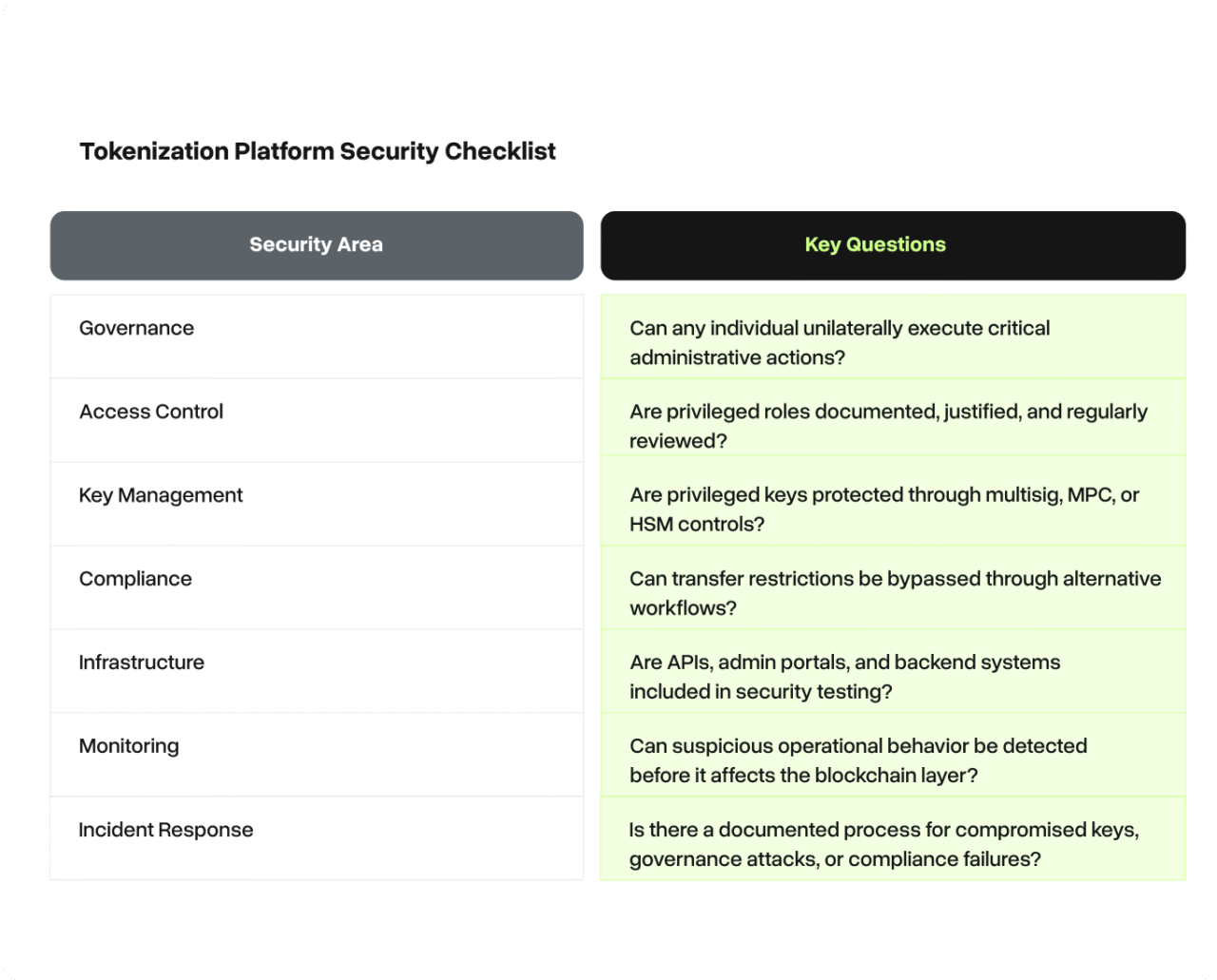
Tokenization Platform Security Checklist
If any of these questions cannot be answered confidently, your platform likely requires additional security review.
How MiCA Raises Security Expectations
Organizations preparing tokenization initiatives for European markets increasingly face higher expectations around security and operational resilience. We cover these requirements in more detail in our MiCA compliance checklist for Tokenization Platforms.
From a technical perspective, this often translates into stronger requirements for:
- Governance transparency
- Access control management
- Auditability
- Security documentation
- Change management
- Operational resilience
- Incident reporting readiness
MiCA does not simply increase attention on smart contract security. It also raises expectations around tokenization platform security, governance, operational controls, and resilience.
It raises expectations across the broader operational environment supporting digital asset services.
As a result, security programs increasingly need to demonstrate not only that systems are secure, but also that organizations can prove how security decisions are made, documented, monitored, and reviewed.
This makes architecture reviews, threat modeling exercises, smart contract audits, and broader blockchain security assessments increasingly important components of platform readiness. This section is provided for technical discussion purposes only and does not constitute legal or regulatory advice.
Key Takeaways for Tokenization Teams
Smart contract vulnerabilities are only one component of tokenization platform security.
The strongest security programs combine:
- Secure smart contracts
- Governance controls
- Operational security
- Key management
- Continuous monitoring
- Incident response planning
- Threat modeling
- Independent security reviews
Organizations building tokenization platforms, stablecoins, and other real-world asset infrastructure should evaluate the entire ecosystem rather than focusing solely on the blockchain layer.
Before production deployment, organizations should validate not only their smart contracts, but also the governance, operational, and compliance systems surrounding them. In most tokenization environments, those areas ultimately determine whether a platform remains secure under real-world conditions.
Before You Go Live
Many tokenization platforms undergo smart contract audits but never receive a comprehensive review of governance controls, operational processes, compliance workflows, and off-chain infrastructure.
If you’re preparing a tokenization platform, stablecoin, or RWA project for production, an independent security assessment can help identify risks that traditional code reviews often miss.
Nextrope works with tokenization platforms, digital asset infrastructure providers, fintechs, and financial institutions to evaluate smart contracts, platform architecture, governance models, and operational security controls before launch.
Ready to launch securely?
Get an independent review of your platform architecture, governance controls, and security posture. Contact us.